I had never come across the phrase "imprecatory prayer" until recently, even if I knew well what it meant. In fact, I have struggled with the concept. The Got Questions site begins to answer the question of what imprecatory prayer is by defining imprecatory.
To imprecate means “to invoke evil upon or curse” one’s enemies.
It goes on to inform the reader that, in the Bible, David is the author of the most imprecatory psalms. These psalms, the site explains, were less about exacting vengeance on enemies than a recognition of the fact that God abhors evil and protects his chosen ones. David compares the enemies pursuing him to lions. It's almost as if the psalmists (David, Asaph and an unknown author) felt that they had to point out evil to God, as if He wouldn't otherwise take notice. They plead their case.
More in number than the hairs of my head are those who hate me without cause; mighty are those who would destroy me, those who attack me with lies. What I did not steal must I now restore? (Psalm 69: 22-23)
Christian Prayer
As Christians, we don't focus a lot on prayers that our enemies come to ruin. It would run counter to the very words of Jesus to "pray for those who persecute you" (Matthew 5:44-48). Praying for bad things to happen to bad people feels at odds with the philosophy shared by Jesus. However, what if those prayers serve as protection for those who would otherwise be prey in the jaws of lions? When do you pray for the lion to be crippled, so that the antelope can escape?
These questions came to me as I prayed for the people of Ukraine a few nights ago. I asked myself what would it take to make them secure. The answer is for the aggression against them to cease. Nothing is impossible for God, but the hardened heart of Vladimir Putin seems difficult to penetrate. The salvation of the Ukrainian nation seems to depend on nothing short of the failure of the Russian war machine to accomplish its goals. It seems only natural to then pray for the total defeat of the Russian military forces and their commander-in-chief.
The Escape
In the book of Exodus, as the persecuted Israelites tried to escape the Egyptians, it was God's wrath visited upon the pharaoh and his forces that made their freedom possible. The pharaoh's heart was hardened, the book tells us, and he refused to have mercy on God's people. When Rome became an empire, the title caesar (the cognomen of Julius Caesar) was attached to its emperors, who behaved as the pharaohs did, and were worshipped and revered in the same ways. The title of caesar became czar in Russia when applied to its emperors. Although the reign of the czars technically ended with Nicholas II after he was deposed by the Bolsheviks, what is Vladimir Putin but a modern-day czar, with all of the powers to go with that designation?
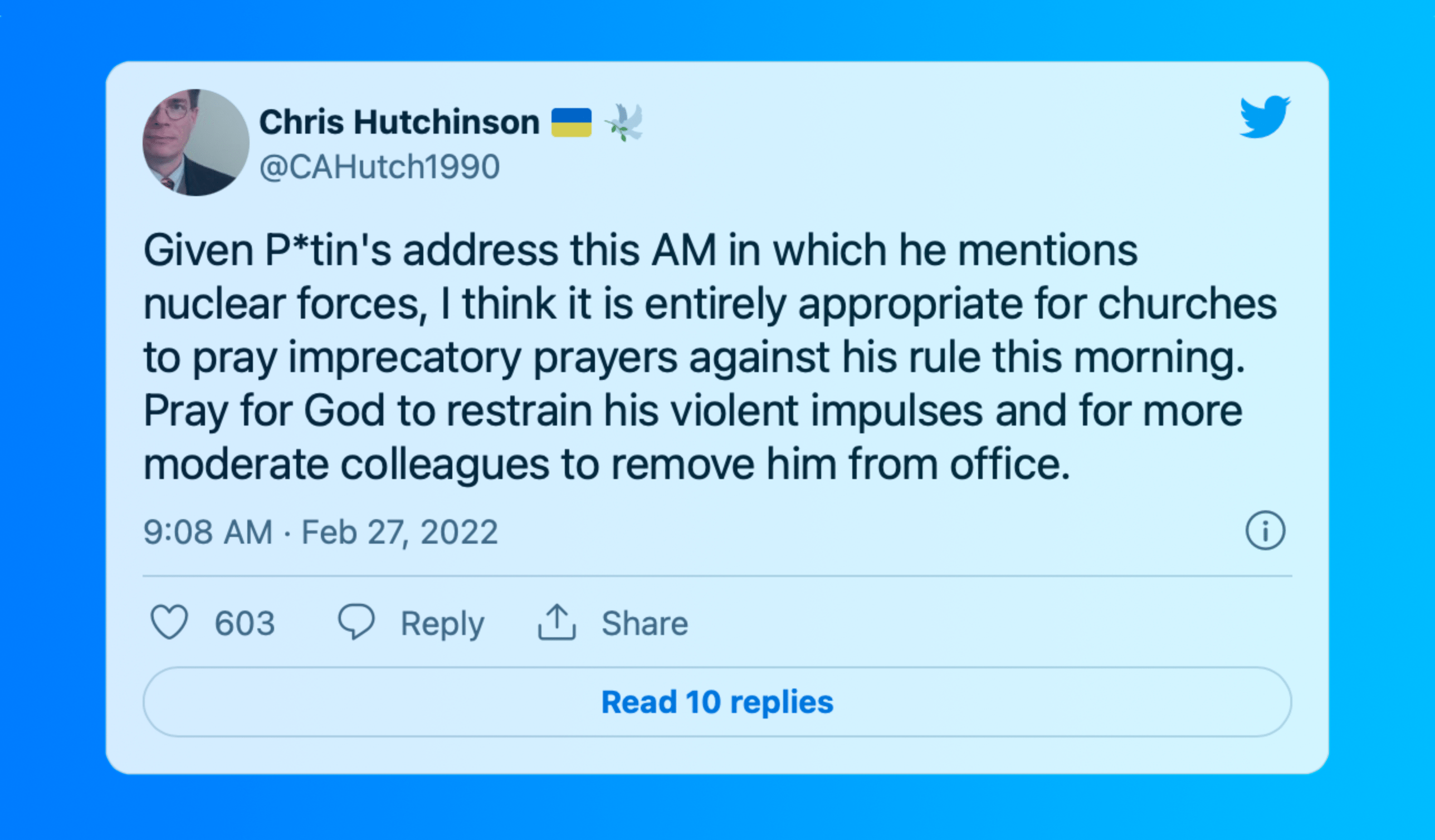
When a modern day czar invades another country and kills its people, are we at a point where we start to pray for his downfall? Presbyterian pastor Chris Hutchinson thinks so.
I'm not sure where this leads. My crystal ball is in the shop. I also don't don't know how else to stem the tide. Prayer is what I know how to do right now. Even if that means praying to end the invasion by regime change, however that may happen.
As I mentioned this week, my great-great-grandfather moved his family from the Ukraine to Minnesota in the 1870s to escape Russian persecution. He was part of the first wave of Mennonites to leave. It got worse for the ones who stayed when the Bolsheviks and Anarchists came through with their assaults on a peaceful people who refused to fight back (though some of them finally did—you can only push people so far). I am praying for the people in Ukraine as they bravely stand up to the Russian aggression, which even the people of Russia do not support. I have hope that this will end badly for the dictator in Moscow.
Normally, I don’t like long tweet threads (haven’t these people ever heard of blogging?). However, this one, from Mark Hertling, is worth looking at to understand why the Russians will have a difficult time capturing and holding Ukraine.
After one of my @CNN appearances, one of the anchors asked me off-air why I had confidence in Ukraine's army to push back agains the illegal Russian military onslaught.
I used a bit of "battlefield math" to explain my rationale. 1/16
I’m currently reading David and Goliath by Malcolm Gladwell and, spoiler alert, the bigger guy doesn’t always win (for some of the same reasons Hertling mentions in his tweets).
Isaac Saul, writing for the centrist news site Tangle, on Glenn Greenwald and others who insisted on a counter-narrative, despite all the evidence that Russia was going to invade Ukraine.
This whole shtick is a good reminder that being heterodox is in and of itself an ideology, if you become so committed to it that you cannot see what is plainly in front of your face. Many on the left and right — from Tucker Carlson to Saagar Enjeti to Krystal Ball to Aaron Mate — suggested we were being lied to when our intelligence agencies told us what was right there for the world to see. Sometimes, in fact more often than not, the mainstream narrative is the one most rooted in truth. That's why it is mainstream.
It’s been interesting to read bloggers ridicule the idea that Russia would invade Ukraine over the past few weeks. They noted the US government had been warning repeatedly that an attack was imminent and had not happened. The iconoclastic writers apparently missing an almost 200k troop buildup and every other sign of an attack was in plain sight. One blogger, Paul Robinson, who ran a blog predicated on the premise that worrying over Russia was consistently overblown, made good on a promise to shut down his blog if an invasion took place.
In line with my last post, Irrussianality has ceased operation as of today.
It’s hard to fathom there were those in the US who chose to believe Russian Foreign Minister Sergei Lavrov, who called the talk of an invasion “hysteria,” just last month, over the US intelligence community. They seemed determined to be what were called “useful idiots” by the disinformation apparatus in the USSR. How many times does the Russian government have to lie about, well, just about everything, before at least people in the US will see the truth for what it is?
There is a whole niche of writers and podcasters who get by solely on the notion that they are offering a more real take than you will get from the mainstream press. That becomes their value proposition, so they have to offer alternative views, despite how irrational or untruthful they may be.
Though I’m trying to stay away from yet more articles that bemoan the divided state of America, I found a particular piece from NPR on how political affiliations are driving people to move pretty interesting. Hypothetically, if the trend were to continue, and people go to where they feel their political beliefs are best respected, I could imagine a situation where our nation really does get divided geographically.
What are the implications of people clustering in Sean Hannity's America, or Rachel Maddow's?
Groups of like-minded people tend to become more extreme over time in the way that they're like-minded," says Bill Bishop, a journalist who wrote the influential book The Big Sort: Why the Clustering of Like-Minded America is Tearing Us Apart in 2008.
I wouldn’t want to live in either Sean Hannity’s America or Rachel Maddow’s. However, I do think Hannity’s would quickly turn into a totalitarian banana republic, if the GOP keeps on their current trajectory. The reality would also hit that the blue states are in large part subsidizing red states.
Of course, In reality, none of this will be brought to its logical extreme. Once the Covid menace dies down, people will have less to fight about and less incentive to move either to escape restrictions or to feel safer.
Jason Ward is kickstarting a new tabletop RPG using the Powered by the Apocalypse engine. Its theme: the band Faith No More. The game takes its title from the band’s breakthrough LP, which featured the hit song, “Epic” as well as a pretty popular cover of Black Sabbath’s “War Pigs.” I’ve played Dungeon World (which relies on PbtA), so I’m familiar with the gaming mechanics, which are pretty robust and yet rely heavily on the fiction to tell a story through the game. I just never thought that Faith No More would be the subject of the next game to use this engine.
Get ready to roll two six-sided dice to succeed in beating Anthony Kiedis in a rap/rock battle.
At work, we name our teams after fancy monsters, so I’ve gone back to the venerable old D&D Monster Manual for ideas on titling the new operational kanban team.
I like this piece from Andy Nicolaides on VR. Many have poked fun at the applications people have designed for virtual reality. It can be an easy target when you see people wandering around with the giant headsets guiding their legless avatars. Or when you witness a "rave" in a virtual space where you just see avatars (with legs) standing around while a video plays on a screen. As one Twitter commenter asked while watching one such rave, "if this is the rave, what does the cool down party look like?"
Nicolaides sees the benefit of such spaces, though, because they give access to those who may not have it in the physical world.
As someone who is socially awkward, though not as extreme as many, I can fully appreciate true social anxiety as a form of mental disability, but there are, of course, many people that are also physically disabled. A VR environment could, potentially offer truly life changing experiences to people that without it couldn’t even dream of taking part in many activities available to VR users today, let alone in the future.
This mentality doesn't have to apply only to VR, though. It could also apply to offering streaming video options for events that are typically thought of as being in-person. Thinking this way makes me strongly supportive of churches continuing online services after pandemic protocols have been lifted.
The day before President’s Day, I went to church for the first time since last summer. I’ve been watching online, well, religiously, since then, but it was a rare treat to go in and see friends and hear music being played live. Vivaldi on violin with our new sound system (which was desperately needed) alone was worth the trip. We had a congregational meeting afterward, so my stomach was starting to get into growling mode by the time I got home. I was making myself lunch while my youngest was playing a game online with his friends. He kept yelling something like, “get him with the crucifix!” From what I could understand, he was using a crucifix to protect his in-game character from hordes of evil spirits.
I had gone to church alone, and my wife and youngest had gone to my in-law’s apartment to do some things for them, as is their routine every Sunday. When I heard my son yelling about the crucifix, it occurred to me that I’d rather have him in church with me. At least there he could be learning about the True Cross, rather than at home playing video games where the cross is merely a weapon to ward off monsters. I recently picked up Skye Jethani’s book, What If Jesus Was Serious, and had started reading it. Jethani describes the book as a devotional for people who hate devotionals. There were several retweets from Jethani’s Twitter account that were posted by people reading the book with their kids. What I had read of the book seemed a little over the level of a nine-year-old, but that can be mitigated by proper explanation of the concepts while reading. For instance, Chapter 2 focused on comparing ourselves to others when using social media. My son is a bit young for social media. However, the chapter presented us with an opportunity to talk about comparing ourselves to others and how God sees value in even those that people overlook.
I tweeted about my resolution and tagged the author in the tweet. He retweeted my post, and it picked up some decent traction, ending up with over 60 likes, including from Michael Wear, former president Obama’s religion advisor. For some time, I kept my tweets protected because of the fighting on Twitter, but I recently changed the setting back to public. I’ve missed being able to respond to the tweets of those who don’t follow me (you wouldn’t believe how many people fit into that category, despite my occasional witticisms). It feels good to be able to tag someone again when I want to voice support for their work.
Now I’ve got a public statement to hold me accountable to my goal. So far, we've been sticking to the routine. I'm hoping we can both get something out of it.
I know, I know, I just wrote about Brothertiger covers of 80s tunes last week in the newsletter. I have to tell you, though, that when I saw Brothertiger had covered brother/sister duo Sophie and Peter Johnston’s “Torn Open,” one of my favorite songs, I was more than pleasantly surprised. While going through my New Music playlist from Apple Music on Friday, like I usually do, I spotted the familiar song title. I literally got goosebumps before I even heard the track.
When I did listen to the song, I marveled out how complete it is. The cover thoroughly captures the sophisti-pop brilliance of the original. Enlisting Yvette Young from the band COVET to cover the vocal parts from Sophie Johnston (which take up the majority of the song) just worked. The verses stop just short of being cloying, and the chorus soars. The vocals from frontman and Brothertiger himself, John Jagos, mainly serve to supplement Young’s. Jagos does a fantastic job mimicking the synth sound from the original track. This cover is a sophisti-pop master work.
Extra credit to those who read this piece examining the brilliant Brothertiger instrumental EP’s that came out during the pandemic.
I did watch some of the Super Bowl, despite my aversion to sports where people regularly get brain injuries. How about those crypto commercials? I had literally just pulled out my phone to click on the QR code bouncing around the screen when that one commercial ended in some crypto plea. It feels like a lot of people own too much crypto and want to sell it to the easily manipulated. FOMO being what it is, they seem to be appealing to a belief that you had better get in or get left behind.
One reason I still have trouble believing crypto currency is money is that there aren’t commercials for money.
I didn’t spend too much time reading about “vibe shift” this week, although it took some serious effort to dodge the truckloads of articles people were unloading on the subject. Maybe next week I’ll embark on my own vibe shift... Details forthcoming.
The aim of a lot of companies (especially in the tech sector) is to get their customers into a subscription service. The recurring revenue adds predictability that helps immensely when doing budget planning. You see subscriptions everywhere now. Low-end fast food chain Taco Bell even started a subscription service. Streaming services are facing a problem with their subscribers, though. They’ve become mercenaries. Subscribers are picking up a service just to watch a single show and then dropping it.
Perhaps Netflix is trying to establish itself as something like a utility: a given, a default, the must-have that comes before all the wants. Other services have other propositions—HBO Max as prestige TV destination, Disney+ for parents—which they hope will hook consumers who sample the latest buzzy hit. But they’re all dealing with the new reality of mercenary streamers who have to be won over not just once, but again and again. We’re looking forward to the next awesome and unique entertainment spectacle that any given service has bankrolled—and to quitting as soon as we’ve watched it.
I only recently became such a mercenary, dropping Netflix probably until Shadow & Bone comes out with Season 2 and I can return to the Grishaverse. Netflix has been hounding me ever since, sending me emails to get back in at $9.99.
Tish Harrison Warren wrote a piece for the New York Times about how churches need to open up to in-person worship again AND get rid of online streaming worship options. Perhaps not surprisingly, the piece received a lot of criticism, particularly within the disabled community. I can understand the pushback. Last spring, when my ME/CFS was at its most severe, I couldn't even watch my church's worship service online when it was streamed in real-time. I felt so badly in the mornings that I would have to wait until later in the day to stream the recorded version of the service. That had nothing to do with COVID and everything to do with a disabling post-viral illness.
Warren does take disability into account, offering that in-home visits can be provided to those who are house bound. As advocates for the disabled have rightly pointed out, though, that's hardly a substitute for being able virtually worship along with the rest of a congregation. Warren's piece is not without its merits, though.
About four years ago, my family had a group of people from our church in their early 20s over to our house. We shared a meal and we asked them what hopes and challenges our church offered to their generation. Their answers surprised me. Over and over, they said, one of the hardest and best things about church was that they had to sit with people of different ages, classes and political beliefs. It was a practice they found inconvenient, yes, but truly grounding, nourishing and good.
I have been saying for years that I think one major benefit of my children attending church is the experience they get of being with people of all ages. In our increasingly siloed society, there are fewer and fewer places where that intergenerational divide is bridged.
My wife notifies me when she sees something on Twitter that outrages her (the other morning, at breakfast, she was pounding on the table and yelling at me), so I first heard about the “banning” of Maus from her. I had some questions as to the credibility of the report but that just turned argumentative. Roger Wm. Bennett has an interesting take on the controversy.
To the best of my knowledge, Maus hasn’t been banned anywhere. I believe it was removed from the curriculum (not from the library even) of just one school district in Tennessee, for dubious or petty reasons (although there were pretty good ones, such as "graphic novels are comic books puttin’ on airs"). The "controversy" is mostly the prestige press and progressive trolls who just can’t get enough of mocking people in flyover country, with an assist from the author hinting that folks in McMinn County probably are Nazis ("I moved past total bafflement to try to be tolerant of people who may possibly not be Nazis, maybe ….")
I checked my memory with a DuckDuckGo search "What really happened in Tennessee with Maus?" and found that CNN (the top hit, actually) accurately reported the curricular nexus even in its headline while every other top hit save one (a pro-Trump "there go the libs hatin’ on normal folks again" gloat) falsely referred to "ban" in the headlines.
I don’t know about the whole “progressive trolls” thing. That’s definitely not how I characterize my wife (honey, if you are reading this, I love you ❤️), but this whole situation really felt like making a mountain out of a molehill. The author hinting the people in Tennessee may be Nazis is a prime example of what’s wrong with discourse in this country. It still amazes me to see what blows up these days. Perhaps you could say that school curricula has always been a contentious subject, but it still feels to me like there’s a shift happening here when removing a graphic novel from a middle school course becomes “Nazis are banning books in Tennessee.”
I follow the blog of DHH from Basecamp, but I pretty frequently find myself disagreeing with his perspectives. He tends to reliably come from a pretty right-of-center perspective. When I do concur, though, his arguments strongly resonate with me. This usually happens on the subject of social media. He has recently argued that friction is necessary in online interactions. The absence of some kind of friction has given license for people to quickly spout off on social media without first really thinking about how they are interacting with others or what they are saying.
From his latest essay, DHH relates that, after leaving social media, and making blogging and email his main forms of communicating online, he has noticed debate becoming a lot more civil. He’s even been posting hot takes on such contentious topics as Canadian truckers and getting reasoned, but differing perspectives.
But what's interesting is how I can envision all of these interesting, courteous, and illuminating email debates rerendered in the realm of Twitter to predictably nasty, bitter outcomes. BY THE SAME PEOPLE!
It's not that there's a new subspecies of homo sapiens inhabiting Twitter, and then another living on email. It's the same people. But the change in environment prompts them to flip from that resentful, incriminating stance in the one area to the curious, good-faith stance in the other. That's both fascinating and heart warming.
It's evidence that humanity hasn't been terminally broken. Even in places like America where it might so often seem like it. We are currently trapped in some bad platforms producing bad outcomes, but the people participating often just need a change of venue for the dark clouds to clear.
I have reduced my reliance on social media in the last few years to where I think I’m in a healthy place. I have noticed that interactions via email tend to be much more rewarding and complete.
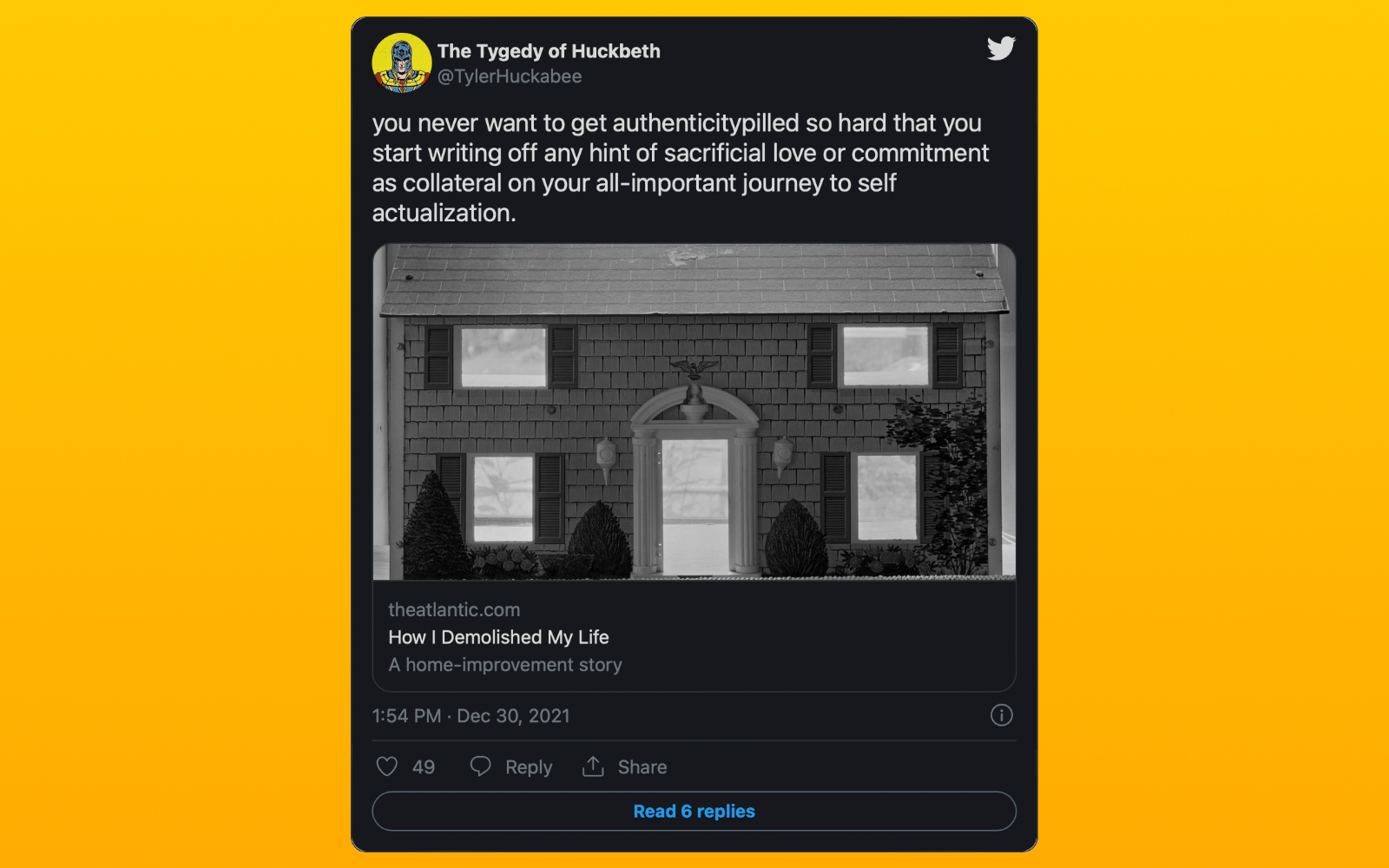
It turns out that not everything I learned in college en route to getting my psychology degree has held up under the weight of time and scrutiny. Take, for instance, Abraham Maslow's "Hierarchy of Needs," which was featured prominently in my education and still holds a large percentage of mind share among the general population in the US. Alex R. Wendel, writing for Mere Orthodoxy, reveals that Maslow's pyramid focuses too heavily on physiological needs. Emotional needs can be just as important for flourishing. For instance, we know that infants who receive total physical care but not affection will experience failure to thrive. The biggest influence that Maslow's hierarchy has had upon popular culture, however, is shaping the perception of self-actualization as an end goal.
People are still drawn into Maslow’s concept of self-actualization not because they find it intellectually valid but because it offers a compelling vision of humanity that allows people to place themselves before all others and shed all sense of altruism or self-sacrifice. People are drawn into the idea of pursuing humanity beyond their current constraints because it tells a story that people do not need to be stuck where they are; rather, they can become something more, something that surpasses everyone else–become Nietczhe’s Übermensch–if they think the right thoughts or do the right things.
The belief in self-actualization has led to a society focused on individuals achieving their "best life," sometimes at the expense of others. For example, I’m seeing a disturbingly increasing number of posts about women leaving their husbands or just slamming their marriages. Articles about how marriage just isn’t satisfying seems to be on the way to becoming a cottage industry now. What’s most distressing about many of these essays is that the women actually like or love their husbands, they are just seeking something more. So, they leave their marriage for “radical self-love,” or some other shameless euphemism for what human beings used to call selfishness.
Author Glennon Doyle, in an interview with NPR, likens being married to a good man to “gaslighting.” She doesn’t seem to understand that gaslighting is being married to a horrible person who hates you and actively does things to make you try to question your sanity. Can we just stop people from using the word gaslighting now, since most people using it don’t seem to understand what it means? In Doyle’s case, she just didn’t feel like she could bring her “whole self” to the table when she was a part of her marriage. It was just ambiguously “unsatisfying.”
Other women just trade in the stock of “familiarity breeds contempt,” and pen screeds about how they hate their husbands in the New York Times. Still others, like Doyle, admit that their husbands are great, but are ultimately impediments to experiencing some kind of other life out there.
I didn’t have a secret life. But I had a secret dream life—which might have been worse. I loved my husband; it’s not that I didn’t. But I felt that he was standing between me and the world, between me and myself.
Feeling stifled, Jones wondered what life would be like separated from her husband.
Who could I be if I wasn’t his wife? Maybe I would microdose. Maybe I would have sex with women.
Marriage can be difficult, there’s no doubt about it. I’m not here to comment on those who take an exit out of a tough marriage. I’ve experienced too much grace in my marriage and in my life to judge. For those who want to leave their spouse, so they can embrace promiscuity or experiment with drugs and resent that the commitment that they made is keeping them from that, I can’t be understanding. Nor do I understand the “I had to get out because I felt a vague sense of malaise” rationales.
Spin magazine posted some rants from musicians and industry insiders who think we need to talk about Spotify. One of the most striking essays came from Kay Hanley, Letters to Cleo songwriter and co-executive director of Songwriters Of North America. She has some bones to pick with Spotify CEO Daniel Ek.
When recording artists complained about the absurdity of having to get millions of streams just to make minimum wage, Daniel Ek told us to work harder and release more music. Spotify executives have said in public that music creators are “entitled” for wanting our fair share while base pay for a software engineer is just south of $200K.
And where are we now? Ek uses the billions he’s made off our work to do very not music business stuff like invest in AI defense tech, and endow a global chit chat platform to a fascist-curious jock. It’s the type of shit that would have put a terrestrial music distributor out of business at any time in music history previous to this one. Spotify sucks. Let’s take our awesome product and go where we’re wanted.
I understood that Spotify was underpaying musicians and I remember the flippant comment that Ek made about artists needing to release more music. It wasn't until recently that I realized just how bad things are, though. Perhaps it's the fact that they are paying Joe Rogan many magnitudes more than the musicians upon whose backs they built the service. Or it could be that they promised musicians better compensation when revenue started to materialize and then instead took them to court to be able to pay them less. All these things combined mean I never want to have anything to do with Spotify.
Fr. James Martin on how a Christian should respond when someone who was not vaccinated dies of Covid.
The problem is that even a mild case of schadenfreude is the opposite of a ‘Christian value.’ Jesus asked us to pray for our enemies, not celebrate their misfortunes. He wanted us to care for the sick, not laugh at them. When Jesus was crucified alongside two thieves, he says to one of them, according to Luke’s Gospel, not ‘That’s what you get,’ but ‘Today you will be with me in paradise.’ Schadenfreude is not a Christian value. It’s not even a loosely moral value. …
Totally agree. Schadenfreude is not a Christian value. However, to point of the previous piece that I linked to: is it okay to have that attitude towards companies like Spotify and Facebook when they lose a ton of market value? The Supreme Court may say that companies are individuals but I for one still can’t get on that train.
Michael Hobbes has a video essay making the rounds that examines whether “cancel culture” is really a threat to America. The problem with the articles, and in this case, videos, that seek to convince us that cancel culture isn’t real is that there is always a pretty good example of cancel culture in the recent past. In this case, you could cite Whoopi Goldberg as a decent representation of someone who was at least temporarily canceled unjustly for being ignorant on a subject of race. Or a guy who works at West Elm. You won’t have to go far back, at any given time, to find someone being punished for a misstep. It could be a professor who is has been reproached and is penitent for something like showing Othello, and for whom apologies and sackcloth and ashes are not enough to satisfy angry and traumatized students. You many even be reminded of cancel culture every day, if you use Firefox as your web browser. Former CEO, Brendan Eich (who created javascript and went on to found the Brave browser), was removed from Mozilla for monetarily supporting Proposition 8 in California. The Brave browser literally wouldn’t exist without cancel culture. Regardless of what you think about the marriage law (which was overturned), in this country, political speech in the form of donations to a cause is protected. Not only was Eich fired, but he was harassed by activists for years afterwards because of his politics.
Tucker Carlson and other Fox News talking heads hyperventilating aside, we may reasonably disagree as to the extent to which our new orthodoxies threaten the republic. To pretend like cancel culture, by whatever name you want to refer to it, is not real, though, is to say, “who are you going to believe, my think piece or your own lying eyes?”
As more companies like Meta and Microsoft start showing off VR tech, there seems to be something commonly missing from the avatars… legs. Since this is a phenomenon across multiple implementations of virtual space, Ivan Mehta wondered why. It turns out that it’s unusual to have VR sensors that take our legs into account.
A lot of that has to do with sensors. Currently, metaverse experiences are largely restricted to VR headsets; some are compatible with handheld controllers, like the Oculus touch controllers. However, there are hardly any commercially available sensors and controllers for our legs. That means your leg movement can’t be accurately detected and depicted in virtual environments.
What would be the consequences of having legs that moved in the virtual universe without us moving them in real life?
He also pointed out that in real life when you look down, you’re used to seeing your legs are at a specific distance away from your face, which you’re used to. But in the virtual world, if that situation is not replicated, it could cause you to feel nauseous. So until there are better sensors to avoid this on headsets, companies might avoid creating legs.
Yikes, I don’t imagine the disorienting feeling that would cause nausea would make VR very pleasant. So for now, the legs will have to be conspicuously absent.
Brothertiger is one of my favorite bands, and I was pretty stoked when I came across their cover of the full Tears for Fears album Songs From The Big Chair on Apple Music. I was able to listen to it a couple of times, then, poof, it was gone. I guessed that it was the result of some kind of cease-and-desist order from the legal arm of Tears for Fears. It looks like I was right because what is probably about 2 years after the album showed up and disappeared, it showed back up like a dream deferred. Only now, it's got an extra goofy title to obscure the fact that it's a Tears for Fears cover album. The album is cheekily now called Brothertiger Plays: Covers From That One Really Good 80's Band.
Fans of 80's mainstream synth pop or chillwave need to give this one a listen. It's just faithful enough to the originals to retain their impact, but also has enough of the Brothertiger glo-fi to modernize the classic tunes.
Favorite track: “Everybody Wants to Rule the World,” obvs.
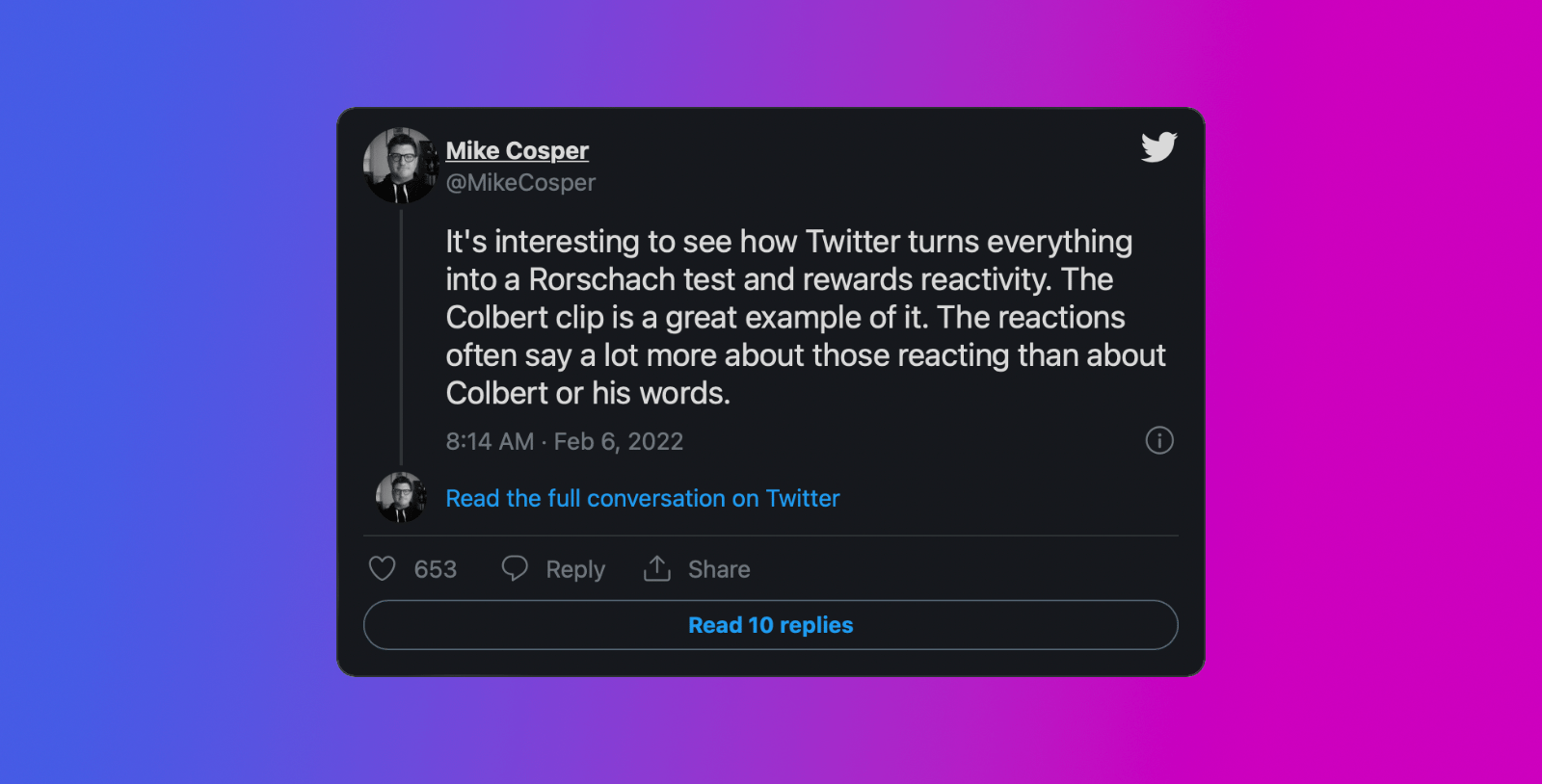
The clip of Stephen Colbert expressing some basics about his faith is making the rounds (especially on Twitter). Tim Keller is an evangelical pastor who saw in the clip a potent witness on a popular talk show.
This is a brilliant example of how to be a Christian in the public square. Notice the witness, but in a form the culture can handle. We should desire to have more Christians in these spaces and give them grace as they operate. https://t.co/0QaXuwzYSa
I guess I shouldn’t be surprised about the negative comments the clip has received, in addition to the praise of popular religious figures, but it’s still disappointing to see them. What Colbert said was obviously not meant to be a full-fledged statement of faith, but rather a snapshot into how faith is integrated into his life. Still, people are commenting about what it left out. They say he didn’t use the opportunity to share the gospel, for example. Commenting on what was left out is like playing gotcha with a tweet, though. You can always find things about a complex religion like Christianity that are left out of a 280 character tweet or a 2-minute sound bit from a talk show. Colbert hosts a mainstream, secular show, not a catechism. It is a beautiful thing that he shared his faith in a way that may actually make people who aren’t Christians curious. His witness being contextualized in a way that secular people can understand doesn’t mean it’s watered down or compromised. It means he is speaking to, and understands, his audience. Kaitlyn Schiess commented on the Holy Post podcast that the kind of fundamentalist thought pattern that opposes contextualization shows, “the poverty of the way we think about evangelism.” She recounted how, when she was a kid, she thought she had to annoy people with her faith to be witnessing properly.
The reason Colbert’s guest, Dua Lipa, asked him about his faith was because people notice that Colbert is open about his beliefs. He isn’t hiding his light under a bushel, as it were. He’s open to talking about the weight of eternity on a late-night show on a major network. How often do you see that?
I met Julia Kwamya at a Radio Dept. show a few years ago. At the time, she went by the band name Germans. She had only released a few songs. I was already a fan because I had heard about her through Kurt Feldman, who produced some of her tracks. However, I had no idea she would be the opening act that night. When I arrived at the Cat’s Cradle, there were only a couple of songs left in her set. I quickly realized my mistake in not getting there earlier and was bummed that I wasn’t able to see her whole performance.
After the set, I was able to speak with Kwamya about her plans for upcoming releases. She had some new tracks she was going to lay down, but Feldman wasn’t going to produce, this time. It sounded as if it was planned and scheduled. Then, years went by, and no new music appeared. It wasn’t until 2021 that she finally came out with her first official EP, under her own name, Feel Good About Feeling Bad. The EP contained some of the same tracks, “Cruel” and “Wonderhow,” that she played that night and which had been circulating for years. The entire collection of songs is a welcome addition to her catalog, though, and the EP has a cohesive sound that would easily convince you all the songs were recorded together. With strong, disco and funk inspired bass lines (the bassist she played with at the Cat’s Cradle was really dynamic), the songs put the listener into a slow groove. Kwamya’s dreamy delivery has a richness that sets her apart from a lot of indie pop vocalists.
Since the release of this EP, Kwamya has put out another single, Little Red, which I hope means that more music is on the way. Dream pop that makes you want to dance hits a sweet spot for me, and it doesn’t get much better than this.
Welcome to the eighth issue of Week on the Web. I hope your week has gone well. After just under a year of not being able to work, I went back to my job this week, albeit at a fraction of the hours I was working previously. While I started off with a lot of energy, as the week went on, that began to wane. It's tough working with chronic illness that threatens to pull you under. When disability works her merciless machinations in your life, you have trouble making solid plans. God willing, I will be able to get used to this new schedule and maybe increase my hours some. I've found out that I need a buffer of at least a couple of hours to actually get things done, outside what I've specified are my official "office hours."
Geriatric Millennials is the new label for those born between 1980-1985. They are said to be the most capable of leading in today’s workplace because they are old enough to remember the analogue age, but young enough to have come of age in the digital age.
I'm a bit older than a "geriatric millennial," which apparently means it will be harder for me to be a capable leader in today's workplace.
I sold my 1992 Data East Star Wars pinball machine a few months ago, partially so I could fund a new computer. My old iMac turns 10 this year, and it now sits in my son's room and has essentially become his. It's somewhat remarkable how long it has lasted and that it continues to be a good working computer (even without the latest two OS releases). My primary computer for the last 2 years has been an iPad, but I have to "borrow" my son's computer to do certain things. I've got my eye on a refurbished M1 iMac of the blue variety, to match my old pinball machine.
Image source: author
The Olympics are upon us, and with seemingly much less fanfare and publicity than have accompanied the games in past years (you could easily be forgiven for not having known they were being held). There are good reasons for the tepid response to these winter games, and most of them have to do with where they are being held: Beijing, China. The BBC has a solid summary of why that location is controversial. Chief among the complaints is the horrific treatment by China of the Uyghur ethnic and religious minority people.
There is also evidence that Uyghurs are being used as forced labour, and that women are being forcibly sterilised. Some former camp detainees allege they were tortured and sexually abused.
Beijing is also accused of restricting the freedom of people in Hong Kong through new legislation including the Hong Kong National Security Law.
In its 2021 annual report, Human Rights Watch said that "Beijing's repression - insisting on political loyalty to the Chinese Communist Party - deepened across the country".
German government ministers boycotting the Games said they were protesting against the treatment of Chinese tennis champion Peng Shuai.
Solarpunk is a genre and art movement that envisions how the future might look if humanity succeeded in solving major contemporary challenges with an emphasis on sustainability, climate change and pollution.
The images that portray the solarpunk aesthetic breath life into a vision of a green future. I love them because they stand in stark contrast to the onslaught of images that we have seen of dystopian futures where the planet lies in waste after humans have leeched it of its natural resources and beauty. Solarpunk is especially necessary now, when we are developing the capability of bringing these visions to life, but are also beset by the pessimism of current events. They remind us that we have to keep looking forward with optimism about how we craft a more human, organic environment, while still allowing the positive developments in technology to coexist.
Perhaps unsurprisingly, Smith brings in conceptual and real-life images from Japan, but also from places like San Antonio (where a coworker of mine is temporarily living, making me jealous). Working within the framework of the five components he lays out, Smith is able to construct a compelling vision for what urban living can look like in the not-too distant future.
Image source: Imperial Boy
Over the past few years, I've read a handful of pieces on the rise and fall of Tumblr, but this one by Kaitlyn Tiffany was still worth taking in. One thing that stood out to me immediately was the account of former CEO Jeff D’Onofrio, who replaced founder David Karp, left under a cloud of secrecy in January. Matt Mullenweg of Tumblr owner Automattic says that he didn't announce the departure for D'Onofrio's "privacy and safety."
Whatever this means—whether Tumblr will shrivel in his absence, or if it’s still up for the challenge of fighting another, another day—many former users already talk about the site in the past tense. The sentiment “I miss Tumblr” circulates regularly on Twitter, where nostalgists tend to refer to the latest topics of conversation or styles of humor as “2013 Tumblr” or “Tumblr season 2,” as in, invented a long time ago … on Tumblr. Some have even gone back to Tumblr to live in its ruins. “i love how irrelevant tumblr is,” begins a Tumblr post that, ironically, went somewhat viral on Tumblr in February 2020. “no celebrities on here, no colleagues or family on here, no one’s famous off tumblr or making money, tbh no ones even updating the site like is there even any staff? who knows? it’s bliss.”
I knew that Tumblr was a pretty toxic place when the first user to try out a feature that lets followers pay for content got death threats. However, I didn't imagine the CEO would have to exit in such a clandestine manner. It's unfortunate that Automattic hasn't been a more capable steward of the service and that it's still seeing decline, but I definitely wouldn't want to be in the business of trying to satisfy Tumblr's hardcore fans.
I recently wrote a mostly positive post about the Disney+ series The Book of Boba Fett.
Here is a piece of feedback that I received.
@frostedechoes I agree, but it's a story I'm not interested in. Tatooine (in Episode IV) was supposed to be unimportant, out of the way, and a dead end for those who live on it, not the epicenter of the entire galaxy. I was not impressed that it was Anakin's home planet in Episode I or Rei's home planet in Episode VII (though that was basically a remake of the first Star Wars, which was also disappointing). The prequels and Episodes VII and IV were narratively terrible, but at least they introduced a bunch of new planets with cool stuff on them. The focus on Tatooine seems to be more about keeping the production budget reasonable than in service of telling a coherent or compelling story.
I can understand where Descy is coming from. Tatooine was supposed to be a backwater, and it has shown up in the various Star Wars properties more than any other location. Boring life on that planet was what caused Luke Skywalker to whine most unflatteringly when we first met him in A New Hope. Now as viewers, we find ourselves stuck there. I had never wondered if it played so prominently because it was cheap to film in a simulated desert setting. That might be taking too cynical a view, though, especially considering the formidable amount of resources Disney can surely contribute to a Star Wars project.
On the blog this week, I shared a post about the recent controversy with Spotify. I like to boost what other people have written about a given subject, and this is probably the most hyperlink-dense post I have written. I'll be interested to see how this situation plays out for Spotify.
Ultimately, it is up to the artists and the consumers if they want to engage in some sort of abstinence regarding Spotify. Whether the protest works with Spotify is up to the company. Folks can blast big tech for censorship, but in a case like this, Spotify is going to respond to what will be acceptable to their customers and also protect their investments in music and podcasts.
Will putting content warnings before all podcasts that contain discussions placate their critics? Somehow, I doubt it.
Of course, controversy is not new to Spotify, and the biggest ongoing controversy is the pittance they pay artists for streaming rights to their music. Many times, artists have no say in the deals, and couldn't pull their music from Spotify even if they wanted to because of the record label's level of control. Some would say this issue, so long contested, is bigger than the Joe Rogan controversy. There is also a strong argument that this topic is less divisive than a subject like Covid vaccines that has entered into the culture war territory. Theoretically, unless you are an executive at Sony or Spotify, you should be supportive of the artists (especially when you look at the data).
lemme put it this way if instead of getting 300 million dollars joe rogan was also getting .003 cents per stream that he then had to split with a record company that was a part owner of spotify i would be standing in solidarity with joe rogan
Jason Morehead had a wonderfully informative piece this week on what happens when fantasy tabletop RPG's bring in science fiction elements. Specifically, he profiles two new games, Starforged and Quest: Cosmic Fantasy Edition. Something that is particularly intriguing to me about Starforged is the ability to play without what they call a guide (what other games typically refer to as a gamemaster or dungeon master). This alleviates the need for heavy planning and allows for both co-op and solo play. I confess that the only way I can play D&D with my 9-year-old is to play an NPC to help guide him, so a co-op resonates with me. I also really appreciate the artwork by Joshua Meehan. The worldbuilding feels quite thorough. Morehead writes:
What I appreciate the most about games like Starforged and Quest: Cosmic Fantasy Edition is how they can fire up one’s imagination even before you play them. As I’ve mentioned before, I’m a sucker for good worldbuilding — and for tools that empower others to build and explore their own imaginary worlds.
I can totally relate. I bought games like Mechwarrior (which was almost impenetrably difficult to play) when I was a kid because I wanted to live in that world, piloting one of those massive machines.
Jason Morehead is currently offering a 50% discount on memberships to his site/newsletter, Opus. His work is well worth supporting.